How to Transfer Property Sale Proceeds From Portugal Abroad: Banks, Currency and Source-of-Funds Checks

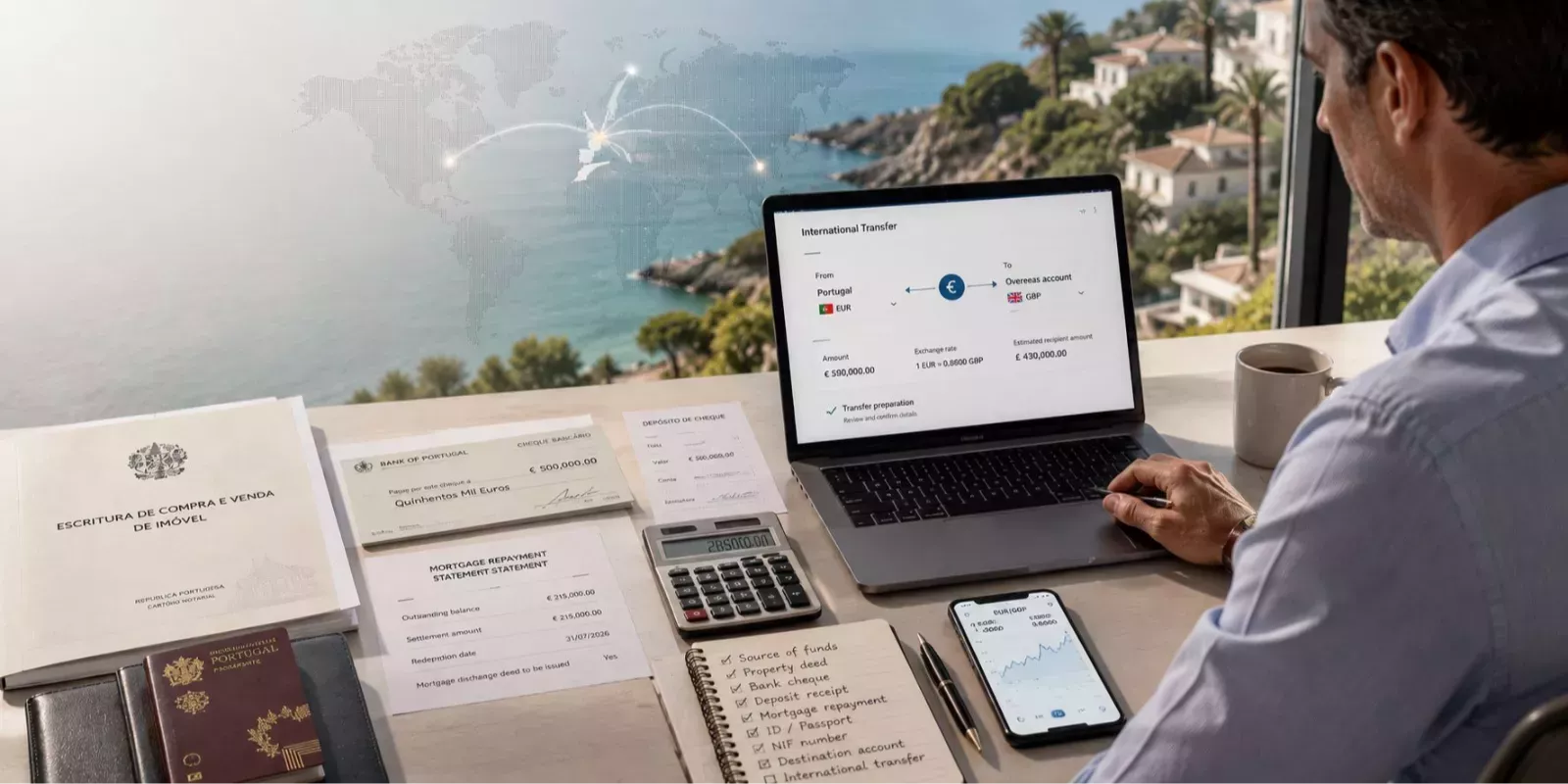
Yes, the proceeds from selling a property in Portugal can normally be transferred to a bank account abroad. Portugal does not generally impose exchange controls preventing a seller from moving legitimate property sale proceeds overseas. However, banks may request supporting documents, delay an instruction or refuse a payment when required by anti-money-laundering rules, sanctions screening, fraud prevention or another legal obligation.
For most international sellers, the difficulty is not obtaining permission to move the money. It is coordinating the payment at completion, any mortgage repayment, the availability of the funds, bank compliance checks, currency conversion and tax reporting in the correct order.
At RE/MAX Cidadela, we have assisted property owners in Cascais, Estoril, Oeiras and Lisbon since 2004. In practice, avoidable delays are more likely when the bank is only informed after completion, the receiving account does not match the seller’s name or the ownership and source-of-funds documents are submitted too late.
Quick summary
Can the buyer pay directly into a foreign bank account?
A buyer may be able to pay the seller directly into an account abroad, provided the structure is accepted by the parties, properly documented and compatible with the banks and mortgage arrangements involved.
This does not mean that every buyer, lender or professional involved must accept every proposed foreign payment route. A sale involving a Portuguese mortgage, several owners, multiple accounts or a bank cheque may require a different structure.
The method of payment should be agreed before the promissory purchase and sale agreement, or at the latest well before completion. The parties should confirm where the balance will be paid, how any existing mortgage will be repaid and which documents the banks will require.
Do you need a Portuguese bank account to sell a property?
A Portuguese bank account is not necessarily a legal requirement. Under EU SEPA rules, a person should not normally be prevented from making or receiving a qualifying SEPA payment solely because the account is located in another EU Member State. The European Commission describes a refusal on this basis as IBAN discrimination.
That principle does not remove legitimate requirements involving mortgage repayment, account ownership, anti-money-laundering checks, transaction limits or the payment method agreed between the parties.
Additional scrutiny may apply when the seller, receiving account, financial institution or destination jurisdiction presents a higher money-laundering or sanctions risk. These controls are normally applied according to the circumstances and do not automatically mean that a foreign seller must open a Portuguese account.
Nevertheless, a Portuguese account can simplify repayment of a local mortgage, deposit of a bank cheque, payment of final property expenses and communication with the institution handling the transaction.
What if the buyer pays by bank cheque?
Bank-issued cheques remain common in Portuguese property transactions, particularly when the purchaser is using mortgage finance. Depending on the lender and the structure agreed for completion, the price may be paid by bank transfer, bank cheque or a combination of both.
A bank cheque is different from an ordinary personal cheque because it is issued by the financial institution rather than simply written by the buyer from a personal chequebook. However, a seller is not generally required to accept payment by cheque. The payment method should therefore be agreed before the deed.
The cheque should identify the correct beneficiary and amount. Portuguese registration guidance also provides for the identification of the means of payment in the transaction instrument, including the cheque number and the bank on which it is drawn when payment is made by cheque.
If the seller receives a bank cheque, the proceeds are not yet available for an international transfer. The cheque must first be deposited into an account capable of receiving it.
For a cheque deposited over the counter, Banco de Portugal states that a cheque drawn on the same bank, or a certified cheque, may be available on the day of deposit. A cheque drawn on a different bank may only become available on the second business day following the deposit. Different timing can apply to ATM deposits because the cheque must first be checked and certified.
Before completion, the seller should confirm:
Keep a copy of the cheque, deposit receipt, deed and bank statement showing the credit. Together, these documents help create a clear source-of-funds trail.
What happens when the buyer uses mortgage finance?
When the purchaser uses a Portuguese mortgage, the buyer’s bank normally makes the approved loan amount available when the purchase and mortgage are formally completed.
The buyer must provide any part of the price not covered by the mortgage from their own funds. This means the seller may receive more than one payment: for example, one bank cheque or transfer representing the mortgage funds and a second payment representing the buyer’s deposit or remaining equity.
The exact arrangement depends on the lender. Some banks may use transfers, others may issue bank cheques, and the payment may be divided between different recipients when the property being sold still has an outstanding mortgage.
The seller’s agent and lawyer should request the final payment breakdown before completion. Every amount should reconcile with the price stated in the deed.
What if the seller still has a mortgage?
Where the property being sold is still mortgaged, part of the purchase price will normally be used to repay the seller’s lender.
Before completion, the lender should provide the amount required to settle the loan on the agreed date and prepare the documentation needed to cancel the mortgage registration.
The money may therefore follow more than one route:
The seller should not assume that the full headline price will enter their personal account. Only the balance remaining after mortgage repayment and any agreed deductions will be available for transfer abroad — see our full guide to selling property in Portugal with a mortgage, including distrate costs and how to calculate net proceeds for a detailed breakdown.
What happens to the money on completion day?
The exact sequence depends on whether the buyer is using finance, whether the seller still has a mortgage and whether payment is being made by transfer or cheque.
In a straightforward transaction, the buyer provides the outstanding price, the deed or authenticated sale document is completed and ownership passes to the purchaser.
If payment is made by transfer, the seller should confirm that the funds have reached the correct account and whether they are available. If payment is made by bank cheque, the seller must deposit it and wait for the applicable availability period.
The amount available to send abroad may still need to account for:
Before arranging an international payment, calculate how much you will actually keep after selling property in Portugal, rather than using the sale price as the transferable amount.
Why does the bank ask where the money came from?
Portuguese financial institutions are subject to customer-due-diligence and anti-money-laundering obligations. A large incoming payment or international transfer that differs substantially from the customer’s normal account activity may therefore trigger additional questions.
A compliance review does not necessarily indicate suspicion. The bank generally needs to establish a clear connection between the property, the seller, the sale price, the account receiving the money and the destination of the funds.
Source of funds means the immediate origin of the money. In this situation, it is normally the sale of the identified Portuguese property.
Source of wealth concerns how the seller originally accumulated or acquired their assets. This may be relevant where the ownership history, transaction value, parties or jurisdiction creates a higher assessed risk.
What documents can the bank request?
Requirements vary between institutions and transactions. A bank or payment provider may request:
The deed is usually one of the most useful documents because it identifies the parties, property and sale price. Ask the sending and receiving banks for their current requirements before completion.
Bank transfer or currency specialist?
A seller transferring euros to another euro account may not need to convert currency. When the destination account is in pounds sterling, US dollars, Swiss francs or another currency, the exchange rate can materially affect the final amount received.
A traditional bank offers familiarity and direct access to the account holding the money. However, its exchange rate may include a margin in addition to the visible transfer fee.
A regulated international-payments or currency provider may offer a different exchange-rate margin and specialist support. Some providers also offer contracts that fix an exchange rate before completion.
These providers still conduct identification and source-of-funds checks. Using one does not bypass bank compliance procedures.
Compare the final amount expected to reach the destination account, not merely the advertised transfer fee.
SEPA, SEPA Instant and SWIFT compared
|
Transfer type |
Typical use |
Currency |
Indicative timing |
|
Standard SEPA |
Euro payments between participating accounts |
Euro |
Normally by the end of the following business day |
|
SEPA Instant |
Eligible participating accounts |
Euro |
Up to 10 seconds |
|
SWIFT or non-SEPA |
Other currencies or institutions outside SEPA |
Multiple |
Variable |
For electronic standard transfers, the beneficiary’s payment provider should normally receive the funds by the end of the business day following receipt of the instruction. Cut-off times, paper instructions and compliance reviews can affect the practical timing.
For eligible instant transfers, Banco de Portugal states that the funds must be made available within a maximum of ten seconds, regardless of the day or time.
SWIFT transfers may involve intermediary or correspondent banks, additional checks and extra charges. The estimated arrival date should therefore be treated as an indication rather than a guarantee.
How much can the exchange rate cost?
|
Amount converted |
Exchange-rate difference |
Financial impact |
|
€500,000 |
0.5% |
€2,500 |
|
€500,000 |
1.0% |
€5,000 |
|
€500,000 |
2.0% |
€10,000 |
On a €500,000 conversion, a difference of only 1% represents €5,000.
Request a written quotation showing the rate, provider margin, fees, possible intermediary-bank charges and estimated amount arriving in the receiving currency.
A forward contract can reduce uncertainty by fixing a rate before completion. However, it may involve a deposit and contractual consequences if the sale is delayed or cancelled.
Must capital gains tax be paid before transferring the money?
The international transfer and the seller’s Portuguese tax liability are separate matters. Moving the proceeds abroad does not remove the obligation to report the sale correctly and pay any Portuguese tax due.
A seller does not generally need to leave the full sale price in Portugal until the final tax assessment. However, transferring all available funds without reserving money for tax and final expenses can create a later liquidity problem.
The taxable gain is not simply the sale price minus the original purchase price. Acquisition-value adjustments, eligible expenses, improvement costs, ownership percentages, residence status and possible exemptions can affect the calculation.
Review the complete guide to Portuguese capital gains tax for non-resident property sellers before deciding how much is genuinely available to transfer.
What should sellers consider in their country of residence?
Receiving legitimate proceeds from a Portuguese property sale does not, by itself, mean that the transfer is taxed merely because the money crosses a border.
However, the property disposal may need to be reported in the seller’s country of tax residence. Where a double-taxation agreement applies, the seller may be entitled to claim relief or credit for tax paid in Portugal.
A specific warning for US persons
A United States person may have to file an FBAR when they have a financial interest in, or signature authority over, foreign financial accounts whose aggregate value exceeds US$10,000 at any point during the calendar year.
A Portuguese account temporarily holding the sale proceeds can therefore be relevant. The FBAR obligation arises from holding or controlling qualifying foreign accounts and exceeding the aggregate threshold. It is not created merely because a wire transfer above US$10,000 is received in the United States.
Common reasons transfers are delayed
The most common problems are practical rather than legal:
Broker’s practical insight
The international transfer should be planned as part of the sale, not treated as an administrative task after the deed.
Ask the buyer or buyer’s bank how the price will be paid. Ask the seller’s bank whether it will accept the cheque, when the funds will become available and what it needs before processing the international transfer.
The receiving bank should also be informed that a substantial payment arising from a Portuguese property sale is expected.
This preparation becomes particularly important when the buyer uses mortgage finance, the seller still has a mortgage, the property was inherited, there are several owners or the proceeds will be converted into another currency.
Pre-completion checklist
Frequently asked questions
Can a bank delay legitimate property sale proceeds?
Yes. A bank may delay a transfer while carrying out compliance, fraud-prevention or sanctions checks. A complete document trail reduces avoidable delays, but processing times cannot be guaranteed.
Can a bank cheque be transferred directly abroad?
No. The cheque must normally be deposited into an eligible bank account first. The funds can only be transferred abroad after they become available.
Can the proceeds be divided between several owners?
Yes, but the allocation should be consistent with the deed, ownership rights and any agreement between the sellers. The banks may request an explanation and account details for each recipient.
Can a lawyer receive and transfer the money?
In appropriate circumstances, an authorised lawyer may handle funds through a client account. This should be agreed in advance and must comply with professional, banking and anti-money-laundering requirements.
Should the Portuguese account be closed immediately?
Usually not. Keep it open until mortgage matters, condominium expenses, utilities, taxes, refunds and other final liabilities have been settled.
A smoother international sale starts before the deed
Transferring Portuguese property sale proceeds abroad is normally manageable when the payment method, mortgage, cheque deposit, documentation, tax reserve and currency strategy are organised in advance.
The seller should not wait until after the deed to ask how the money will be received or transferred.
RE/MAX Cidadela has supported property owners in Cascais, Estoril, Oeiras and Lisbon since 2004. We coordinate the selling process from valuation and preparation through negotiation and completion, working alongside the seller’s lawyer, accountant and bank.
Planning to sell Portuguese property as a non-resident?
Contact RE/MAX Cidadela for a strategic review of the sale and the practical steps that should be organised before completion.
RE/MAX CIDADELA
Avenida 25 de Abril nº 722, Cascais.
Tel.+351 967604141. E-Mail: ppettermann@remax.pt
⭐️⭐️⭐️⭐️⭐️ 4.6 stars on Google Reviews | 190+ verified client reviews
Local Specialists in:
----------------------------------
👤About the Author
By Pedro Pettermann
Pedro Pettermann is a Broker at RE/MAX Cidadela in Cascais, with over 20 years of experience in the real estate market across the Cascais coastline, Lisbon, Oeiras, and Sintra. With an MBA from IE Business School, he combines strategic vision with deep local expertise. Recognized as a specialist in the real estate market, mortgage financing, and digital marketing, he helps owners and buyers make confident and profitable decisions.
At RE/MAX Cidadela, we have already helped more than 4,800 families successfully sell or buy the home of their dreams
Selling a Property in Portugal With a Mortgage: Distrate, Costs and Net Proceeds
You can sell a property in Portugal even when it still has an active mortgage. However, the outstanding loan must be settled and the mortgage charge must be cancelled as part of the transaction. This normally requires early coordination with the bank, an accurate settlement statement and the docume
Selling a Property with a Tenant in Portugal: Rules, Risks and Buyer Impact
Yes, you can sell a property with a tenant in Portugal. However, the sale does not normally end the tenancy. The buyer usually becomes the new landlord and must respect the existing lease, including its rent, duration, renewal conditions and any legal protections held by the tenant. For the seller,
Expert Guidance for Selling your property in Cascais
Selling property in Cascais or Lisbon is not “list it and hope”. The secure way is a 3-pillar approach: price it from real transaction evidence, de-risk the legal/tax side before you go live, and market it to qualified buyers (local + international) with a clear strategy. In the Line of Cascais, a

