What Adds Value to a Property in Cascais? 12 Key Factors
RE/MAX CIDADELA
Last update: 2026-08-02
RE/MAX CIDADELA
Last update: 2026-08-02
Two homes in Cascais can have the same typology, a similar floor area and even the same postcode, yet sell for very different prices.
The difference is usually explained by a combination of factors buyers consistently value: the exact street, sea proximity, walkability, views, parking, outdoor space, condition, building quality and complete documentation. For premium apartments and villas, privacy, security, swimming pools and condominium quality can also influence demand.
Drawing on RE/MAX Cidadela’s experience valuing and selling properties across Cascais, Estoril, Carcavelos, Parede and Alcabideche since 2004, this guide explains how these factors influence real buyer decisions in different parts of the municipality. It also shows why no feature carries an automatic percentage premium and why street-level evidence matters more than generic formulas.
For current sold-price benchmarks, see our companion guide: Cascais Property Prices 2026: What Homes Really Sold For. That article focuses on the numbers; this guide explains the features that push a property towards the top or bottom of its market category.
Quick summary
What Adds the Most Value to a Property in Cascais?
Buyers in Cascais do not compare only typology and square metres. They compare the experience of living in a particular property: how quiet the street is, whether they can walk to the beach or railway station, how much natural light the home receives and whether it is ready to occupy without legal or technical complications.
The relative importance of each factor changes according to the property type. A T1 apartment in central Cascais is not assessed in the same way as a five-bedroom villa in Birre or Alcabideche. Location and documentation matter in both cases, but a central apartment may depend more on walkability, parking and lift access, while a villa may be judged more heavily on privacy, garden quality and security.
|
Factor |
Typical influence |
Particularly relevant for |
|
Exact microlocation |
Very high |
All property types |
|
Walkability |
Very high |
Central apartments, expats and retirees |
|
Sea views |
High but variable |
Coastal apartments and villas |
|
Parking and lift |
High |
Central and older apartments |
|
Outdoor space |
High |
Apartments with terraces, family homes and villas |
|
Privacy and security |
High |
Villas and second homes |
|
Documentation |
Critical |
All sales, especially financed transactions |
1. Exact Street and Microlocation
Parish-level averages hide large variations. Within the same neighbourhood, one street can achieve materially stronger prices than the street beside it.
Road and railway noise, gradients, nearby construction, motorway access and the general quality of surrounding buildings all shape buyer perception. A quiet, attractive street within walking distance of the seafront will usually compete differently from a similar property on a busy road, even when both share the same postcode.
This is why a reliable valuation in Cascais should begin at street level. Buyers often decide between two similar homes based on the block, immediate surroundings and ease of daily life rather than on the parish name alone.
2. Sea Views and Proximity to the Coast
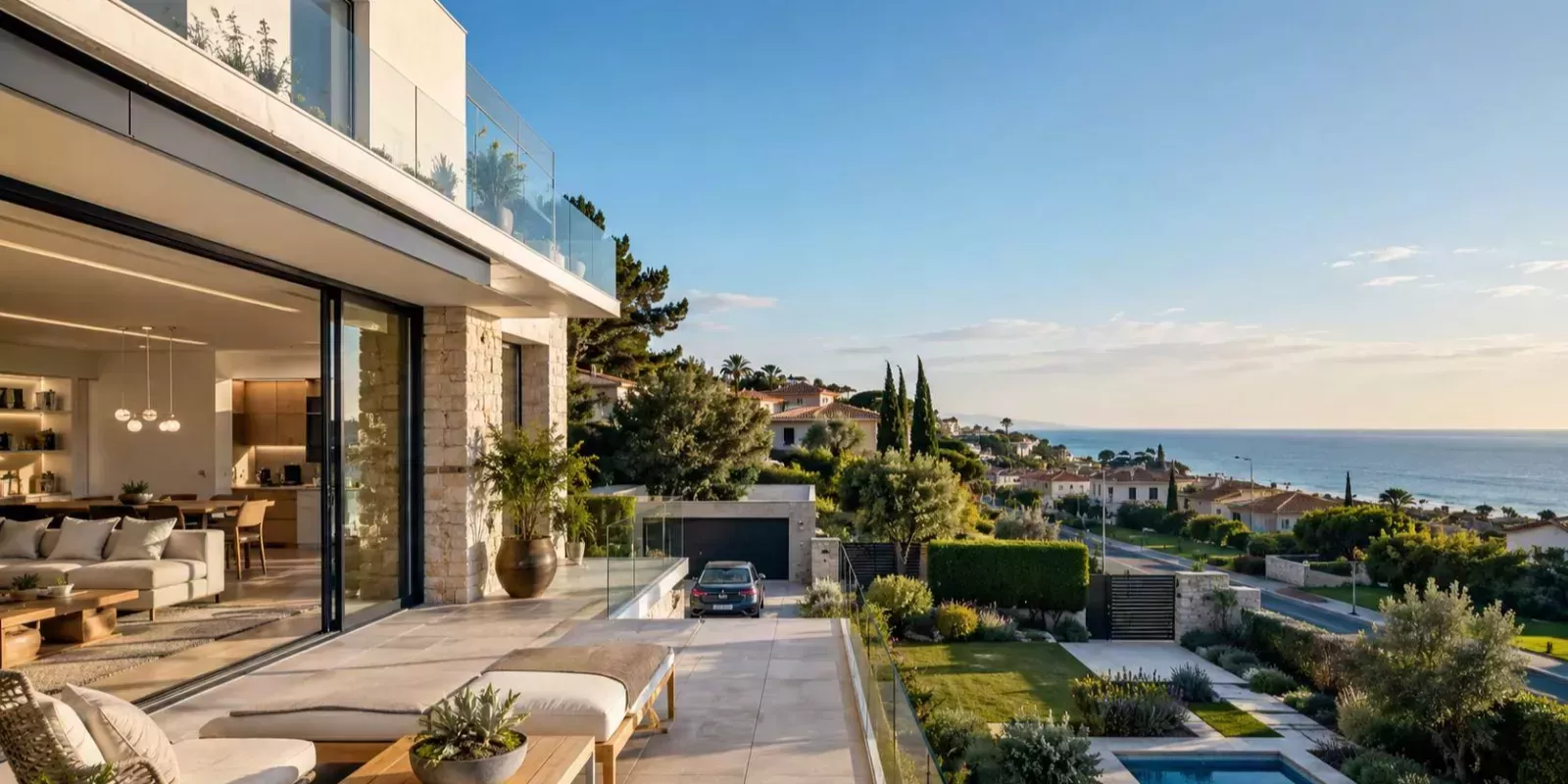
A sea view is one of the most desirable features in Cascais, but not all views have the same market impact.
A panoramic, unobstructed Atlantic view from the living room and terrace is a very different product from a partial glimpse visible only from one bedroom. Buyers also consider whether the view is protected or could be reduced by future construction, vegetation or neighbouring buildings.
Coastal proximity can add value even without a direct view. Homes within easy reach of the seafront in Cascais, Estoril, Carcavelos and Parede often attract buyers who prioritise lifestyle, rental appeal and access to outdoor activities.
In practice, a partial sea view does not always compensate for poor layout, lack of parking or the absence of a lift. Buyers may prefer a more functional home with outdoor space and parking over a higher-floor apartment requiring major renovation.
3. Walkability to Beaches, Shops and Transport
Walkability has become one of the clearest dividing lines in the Cascais market.
Buyers increasingly value being able to reach beaches, cafés, supermarkets, schools and railway stations on foot instead of depending on a car for daily life. This is especially relevant in central Cascais, Estoril, Carcavelos and Parede, where compact neighbourhoods compete directly with more car-dependent locations.
For relocating buyers, retirees and second-home owners, walkability may rank alongside sea views as a deciding factor. It can also widen rental demand because tenants often value proximity to transport and services.
The impact is not identical everywhere. In areas where buyers expect larger plots and greater privacy, such as Birre or parts of Alcabideche, car dependency may be more acceptable if the property offers other benefits.
4. Parking, Garages and Lift Access
Parking has real value in central locations where street parking is scarce. A garage or dedicated space can widen the buyer pool and reduce one of the main objections to an otherwise attractive apartment.
Lift access has a similar effect in older buildings. Its absence becomes increasingly important on higher floors and can exclude older buyers, families with young children and anyone planning to age in place.
Neither feature creates an automatic fixed premium. Their value depends on scarcity. Parking matters most where it is difficult to find, and a lift matters most where the floor level would otherwise limit demand.
5. Renovation Quality and Property Condition
A well-renovated property generally sells faster and appeals to more buyers, but the market does not automatically reimburse every euro invested.
Buyers distinguish between essential repairs, cosmetic upgrades, quality renovation work and highly personalised finishes. Neutral improvements to kitchens, bathrooms, flooring and layouts usually appeal to a broader audience than bold design choices that reflect only the owner’s taste.
Condition also affects financing and perceived risk. Damp, outdated electrics, poor insulation or structural concerns may reduce the number of buyers willing or able to proceed.
Owners preparing a property for sale may also find it useful to review our guide to depersonalising a home to sell faster.
6. Balconies, Terraces and Gardens
Usable outdoor space is highly valued in Cascais because it supports the indoor-outdoor lifestyle many buyers associate with the region.
However, usability matters more than size alone. A smaller terrace with good sun exposure, shelter and privacy may be more attractive than a larger balcony exposed to wind or direct overlook.
For family homes, a private garden can broaden demand significantly. Buyers also assess maintenance needs, drainage, orientation and whether the outdoor space is proportionate to the property.
In coastal locations, wind exposure and salt corrosion should also be considered. Poorly protected terraces, railings and window frames may require more maintenance than buyers initially expect.
7. Swimming Pools
A swimming pool can be a strong differentiator for villas and premium homes, particularly among relocating families and international buyers.
Its value depends on privacy, condition, safety, maintenance costs and how well it fits the plot. A pool that leaves too little usable garden space, dominates a small plot or is clearly visible from neighbouring properties may add less value than an owner expects.
Pools tend to have the strongest impact when they are well integrated into the outdoor area, receive good sun exposure and are supported by genuine privacy.
8. Gated Communities and Condominium Amenities
Security gates, landscaped gardens, communal pools, gyms, concierge services and visitor parking can strengthen demand, particularly in developments aimed at families, international buyers and second-home owners.
These amenities are only valuable when they are well maintained and proportionate to the condominium charges. Buyers look beyond the brochure and assess the quality of management, the condition of shared areas and whether the services are genuinely useful.
A gated community with poor maintenance or high charges may undercut the premium it is meant to create.
9. Privacy and Security
For villas and higher-value properties, privacy and security are often decisive.
Controlled access, mature hedging, walls, distance from neighbouring plots and limited direct overlook can materially strengthen buyer interest. These features matter particularly to second-home owners and buyers who expect to leave the property unoccupied for part of the year.
Security works best when combined with privacy and convenience. A highly protected property may still lose appeal if it feels isolated from schools, shops, beaches and transport.
10. Energy Efficiency and Year-Round Comfort
Energy performance is becoming more relevant as buyers compare the future running costs and comfort of different homes.
Good insulation, efficient windows, heat pumps, solar panels and effective heating and cooling can influence preference between otherwise similar properties. This is particularly important in older buildings, where retrofitting may be expensive.
Along the Cascais coastline, buyers may also examine humidity, wind exposure, salt corrosion and the condition of façades, roofs and window frames. An energy certificate alone does not determine value; buyers assess how the property actually performs throughout the year.
11. Building Quality and Condominium Management
For apartments, the condition of the building can be as important as the condition of the unit.
Buyers may review façades, roofs, lifts, garages, common areas, plumbing, reserve funds and any approved or anticipated works. A renovated apartment inside a poorly managed building may not achieve the same value as a similar unit in a well-maintained condominium.
Transparent accounts and healthy reserves reassure buyers that they are less likely to inherit major deferred costs. Poor maintenance, unresolved disputes or repeated extraordinary contributions can weigh on value.
12. Documentation and Licensing
Documentation problems can reduce value even when the property itself is attractive.
Unlicensed extensions, discrepancies between the registered plan and the existing layout, missing habitation licences or unclear boundaries can delay a transaction, restrict mortgage financing and lead buyers to reduce their offers.
Buyers may accept dated finishes, but an unlicensed extension or inconsistent registered area can prevent bank approval and materially reduce the number of viable buyers.
Before marketing a property, owners should review the documents required to sell a property in Portugal.
What Can Reduce the Value of a Property in Cascais?
The same logic works in reverse. Certain characteristics consistently reduce buyer demand or require a more cautious asking price.
Common examples include:
None of these factors automatically prevents a successful sale. However, they should be reflected in the asking price, resolved before marketing or addressed transparently within the sale strategy.
Does a Sea View Add a Fixed Percentage to the Value?
No. There is no universal percentage that a sea view adds to a property in Cascais.
The effect depends on whether the view is panoramic or partial, whether it is visible from the main living areas, whether it is likely to remain protected and whether it is combined with good orientation, privacy and outdoor space.
A panoramic Atlantic view from the living room and terrace of a well-oriented apartment may command a substantial premium over a comparable unit without a view. A narrow glimpse from one bedroom may influence buyer interest more than the final agreed price.
This is why municipal averages and automated calculators cannot replace an inspection of the specific property.
Does Renovating Before Selling Always Pay Off?
Not automatically.
Essential repairs that remove damp, electrical risks or structural concerns often protect value because they eliminate objections that would otherwise worry buyers or lenders. Neutral improvements to kitchens, bathrooms and flooring may also widen demand.
Highly personalised renovations are less predictable. What one buyer considers luxurious, another may see as a cost to reverse. Owners should therefore focus on improvements the current market is likely to reward rather than assuming that higher expenditure will lead to a proportional increase in sale price.
A local valuation before renovation can help identify which works are commercially justified and which are unlikely to be recovered.
How a Professional Valuer Adjusts for These Features
A professional valuation does not simply add or subtract a fixed percentage for every feature. It weighs how the property compares with the homes buyers can purchase today and with similar properties that have recently sold.
1. Confirm the property’s characteristics
The process starts with the property type, registered area, layout, floor, parking, outdoor space, orientation, condition, views, energy performance, building quality and legal status.
2. Select genuine comparable properties
Useful comparables share the same microlocation, typology, size, condition and buyer profile. A property in the same parish is not necessarily a valid comparison.
3. Analyse sold evidence and current competition
Recent transactions show what buyers have actually paid. Active listings show what the property will compete against. Homes that failed to sell or required repeated price reductions also reveal what the market rejected.
4. Adjust for the individual property
The final estimate considers the specific combination of features present, including views, renovation quality, parking, privacy, outdoor space, building condition and documentation. These adjustments should be supported by market evidence, not arbitrary rules of thumb.
For sold-price benchmarks and asking-versus-sale analysis, see Cascais Property Prices 2026: What Homes Really Sold For.
Frequently Asked Questions
What Single Factor Adds the Most Value to a Property in Cascais?
There is no single factor that dominates in every case. Exact microlocation and walkability have the broadest effect across property types, while sea views, privacy and pools tend to matter more in the premium segment.
Does a Garage Always Add Value in Cascais?
A garage or dedicated parking space generally widens demand, especially in central areas where street parking is limited. Its impact is weaker where parking is already standard.
Is a Swimming Pool Worth the Investment for Resale?
It depends on the property and plot. Pools tend to add the most value to private villas with sufficient garden space, privacy and strong family or international-buyer demand.
Do Documentation Issues Always Reduce the Sale Price?
They commonly reduce buyer confidence and may restrict mortgage financing. Resolving issues before marketing is usually more effective than accepting the discount buyers apply to unresolved legal uncertainty.
Should I Renovate Before Requesting a Valuation?
Not necessarily. A valuation in the property’s current condition can identify which improvements are likely to be rewarded and which may not be recovered in the sale price.
The RE/MAX Cidadela Broker’s View
Owners often ask which single feature they should improve to increase value. In practice, the more useful question is how the property’s existing features work together and how they compare with the alternatives available to the same buyer.
A panoramic sea view may not compensate for the absence of a lift, parking or functional layout. A renovated interior may not achieve its potential if the documentation cannot support mortgage financing. A pool may add value to a private villa but create little advantage if it removes most of the usable garden.
Value in Cascais is rarely determined by one characteristic in isolation. It is determined by how the property performs as a complete proposition for the buyer most likely to purchase it.
That is the judgement an automated percentage calculator cannot replace.
What Is Your Cascais Property Really Worth?
Understanding the factors that influence value is the first step. Knowing how they apply to a specific property requires recent market evidence, local knowledge and an inspection.
RE/MAX Cidadela has been valuing and selling properties across Cascais, Estoril, Lisbon, Oeiras and Sintra since 2004. Our valuations consider recent transactions, current competition, the property’s individual features, its legal status and the buyer profile most likely to respond.
Request a Free Property Valuation and receive an evidence-based assessment of your property rather than a generic checklist or automated estimate.
RE/MAX CIDADELA
Avenida 25 de Abril nº 722, Cascais.
Tel.+351 967604141. E-Mail: ppettermann@remax.pt
⭐️⭐️⭐️⭐️⭐️ 4.6 stars on Google Reviews | 180+ verified client reviews
Local Specialists in:
----------------------------------
👤About the Author
By Pedro Pettermann
Pedro Pettermann is a Broker at RE/MAX Cidadela in Cascais, with over 20 years of experience in the real estate market across the Cascais coastline, Lisbon, Oeiras, and Sintra. With an MBA from IE Business School, he combines strategic vision with deep local expertise. Recognized as a specialist in the real estate market, mortgage financing, and digital marketing, he helps owners and buyers make confident and profitable decisions.
At RE/MAX Cidadela, we have already helped more than 4,800 families successfully sell or buy the home of their dreams
Retiring in Cascais: Discover Your Paradise in Portugal
Cascais has become an increasingly popular destination among retirees from the United States seeking a place to enjoy a peaceful and amenity-filled life. In this article, we will explore the reasons that make Cascais an ideal place for retirees, highlighting the main attractions, services, and
Mortgage Rules in Portugal: LTV, Foreign Income, Rates & Approval Timeline
Mortgage Rules in Portugal 2026: LTV, Foreign Income, Rates & Approval Timeline — if you are a foreign buyer looking to purchase property in Cascais or Lisbon, here is the direct answer: yes, you can get a mortgage in Portugal, but under specific conditions. Most banks finance between 60% and 70% fo
Why Cascais is the Safest Place to Buy a Home in Portugal
Safety in Cascais is a factor that attracts both tourists and residents, creating an environment where the quality of life is high and crime rates are low. In this article, we will explore the various aspects that make Cascais one of the safest cities in Portugal.

