Documents Needed to Buy Property in Portugal: 2026 Checklist
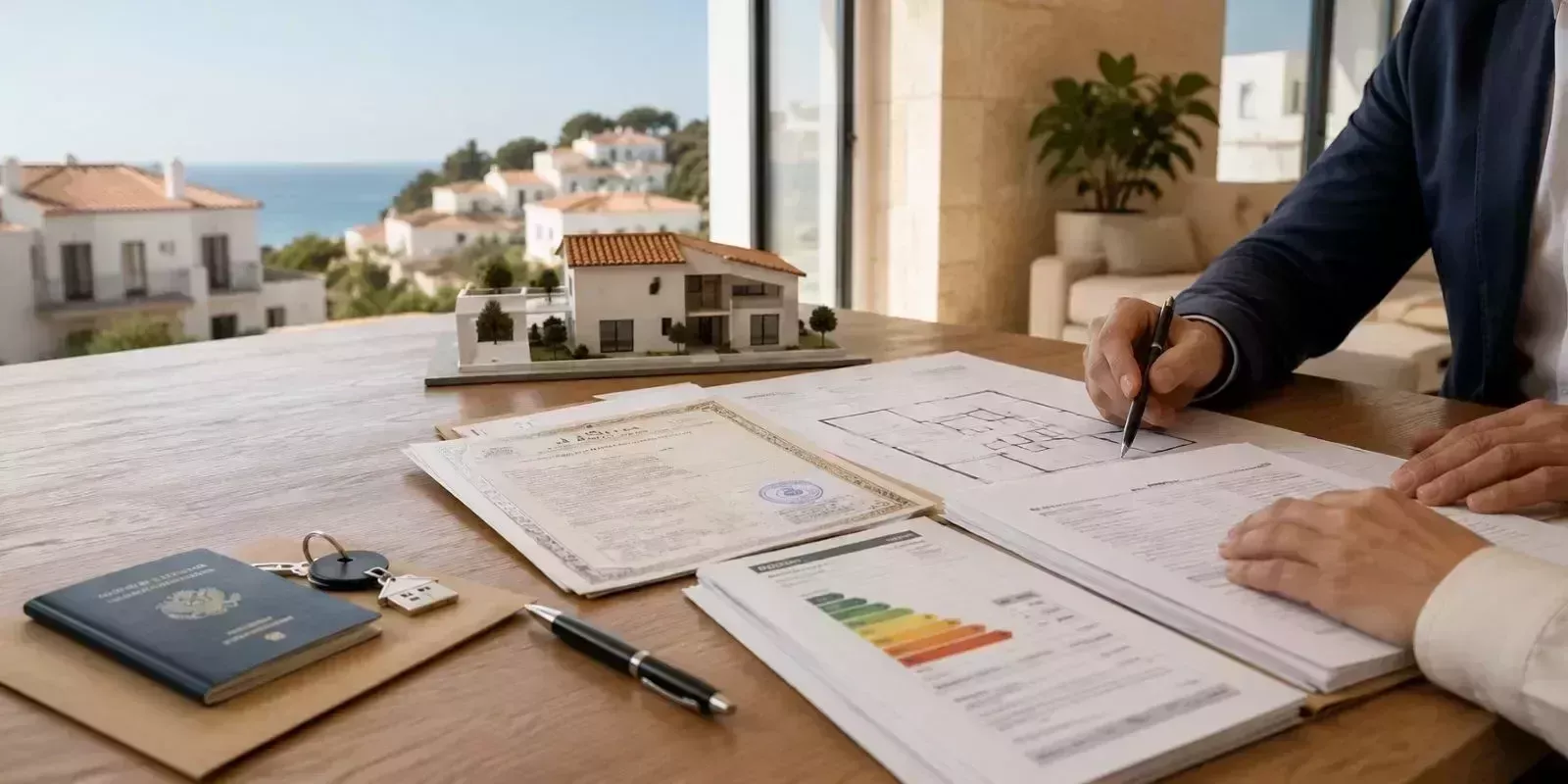
Buying property in Portugal requires three main groups of documents: the buyer's personal identification, the property's legal and technical records, and the documents needed to complete the transaction. Additional paperwork may be required for mortgage financing, anti-money laundering checks or purchases made from abroad.
The essential documents include a valid passport or identity card, Portuguese tax number (NIF), Land Registry Certificate (Certidão Permanente), Property Tax Record (Caderneta Predial) and Energy Performance Certificate (Certificado Energético).
But obtaining these documents is only the beginning. Buyers must also verify that the seller has the authority to sell, that the property has no unexpected legal charges and that its construction and use comply with the relevant planning rules.
Since 2004, RE/MAX Cidadela has helped more than 4,800 families buy and sell property in Cascais, Lisbon, Oeiras and Sintra. Our experience shows that some of the most expensive property mistakes arise not from missing documents, but from information that was never properly checked.
This 2026 guide explains which documents you need, who provides them, what to verify before signing the CPCV and how to prepare for the final deed.
Quick Summary: Documents Needed to Buy Property in Portugal
1. What Documents Do You Need to Buy Property in Portugal?
The exact paperwork depends on whether you are buying with a mortgage, purchasing from abroad or acquiring a property with specific legal or planning issues.
The following table summarises the essential documentation.
|
Document category |
Main documents |
Who normally provides them |
|
Buyer's personal documents |
Passport or ID, NIF, address and marital-status information |
Buyer |
|
Property documents |
Land Registry, Property Tax Record, Energy Certificate, planning records and condominium documents |
Usually Zeller |
|
Transaction documents |
CPCV, tax documentation, final deed and registration records |
Parties and professionals involved |
|
Additional documents |
Mortgage paperwork, source-of-funds evidence, powers of attorney and company records |
When applicable |
Not every document is legally mandatory in every purchase. Some are required to complete the transaction, while others are requested by financial institutions or recommended for legal due diligence.
The important distinction is between having sufficient paperwork to transfer ownership and having enough information to buy safely.
2. Buyer's Personal Documents: What You Need
Before making a formal offer, prepare the documents needed to establish your identity and legal circumstances.
Passport or identity card
Portuguese buyers normally use their Cartão de Cidadão. Foreign buyers generally present a valid passport or another legally accepted identification document.
Your name should appear consistently across the reservation agreement, CPCV, banking records and final deed.
Differences involving married names or foreign name spelling can delay the transaction.
Portuguese Tax Identification Number — NIF
The Número de Identificação Fiscal (NIF) is essential for buying property in Portugal.
Both residents and non-residents can obtain a NIF, which is used to identify the buyer for tax and transaction purposes.
The official NIF application is free, although professional assistance may involve fees.
Foreign buyers should confirm whether their circumstances require a Portuguese tax representative or whether the relevant electronic notification arrangements are sufficient.
For the application procedure, read our guide to getting a NIF in Portugal.
Proof of address and marital status
Banks, estate agencies and other regulated professionals may request proof of your residential address, such as a utility bill, bank statement or official correspondence.
Buyers must also provide the marital-status information relevant to the transaction.
Where applicable, supporting documents may include marriage certificates, divorce judgments or evidence of the matrimonial property regime.
Foreign certificates sometimes require legalisation, an apostille or certified translation.
Power of attorney — Procuração
If you cannot attend the signing in Portugal, you may appoint a representative through a valid Procuração.
The document must authorise the relevant acts, such as signing the CPCV or completing the purchase.
A power of attorney issued abroad may require notarisation, an apostille or legalisation, and translation, depending on the country and the receiving authority.
3. Which Property Documents Should the Seller Provide?
Property documents establish what you are buying, who legally owns it and whether restrictions or liabilities may affect the purchase.
The seller normally makes the relevant records available, but the buyer should ensure that the documents are independently reviewed.
|
Document |
What it helps verify |
Main risk |
|
Land Registry Certificate |
Ownership and registered charges |
Mortgages, seizures or usufructs |
|
Property Tax Record |
Tax identification, registered areas and taxable value |
Inconsistent property information |
|
Energy Certificate |
Energy efficiency classification |
Missing or invalid certification |
|
Planning records |
Approved construction and authorised use |
Unauthorised alterations |
|
Condominium declaration |
Charges and outstanding debts |
Unpaid condominium liabilities |
|
Condominium minutes |
Budgets and approved works |
Unexpected future expenditure |
|
Mortgage release documents |
Cancellation of existing charges |
Property not transferred as agreed |
|
Pre-emption documentation |
Compliance with applicable preference rights |
Delays or legal challenges |
Land Registry Certificate — Certidão Permanente do Registo Predial
The Certidão Permanente is one of the most important documents when buying property in Portugal.
It identifies the registered owner and shows relevant registrations, including mortgages, seizures, usufructs and pending registration requests.
Your legal adviser should confirm that the seller has the authority to sell and that any existing charges can be properly addressed.
How long is the Land Registry Certificate valid?
The certificate is valid for six months and can be consulted online using its access code. During that period, the information is kept updated as registrations change.
Official costs in 2026 are:
Even when the certificate remains valid, its contents should be checked again before completion.
Official source: Portuguese Ministry of Justice — Land Registry Certificate.
Property Tax Record — Caderneta Predial
The Caderneta Predial is issued by the Portuguese Tax Authority.
It contains the property's fiscal identification, registered characteristics, areas and taxable value (Valor Patrimonial Tributário, or VPT).
It should be compared with the Land Registry Certificate, approved plans and the actual property.
For example, an enclosed balcony, converted garage or extension may appear in the property advertisement without being consistently reflected in official records.
A discrepancy does not automatically prevent a purchase, but its cause must be investigated.
Important: The Property Tax Record is a fiscal document. It does not prove that every alteration to the property is legally authorised.
Energy Performance Certificate — Certificado Energético
An Energy Performance Certificate is generally required when selling residential property, subject to statutory exemptions.
It identifies the energy efficiency rating and provides recommendations for improvement.
Buyers should confirm that the certificate refers to the correct property and remains valid.
However, it does not replace a technical inspection of the roof, plumbing, electrical systems, structure or possible damp problems.
Learn more in our guide to energy ratings for international buyers in Lisbon and Cascais.
Usage Authorisation and Housing Technical File: What Changed in 2024?
Two Portuguese documents frequently cause confusion among international buyers:
Decree-Law 10/2024 removed the general obligation to exhibit these documents during the legal transfer of ownership, with effect from 1 January 2024.
This does not mean that unauthorised construction has become legal.
Buyers should still investigate approved plans, the property's authorised use and any subsequent alterations.
A property may be transferable while having planning problems that affect future renovations, mortgage approval, insurance or resale.
If there are doubts about an extension, converted attic, garage or swimming pool, request the relevant municipal records and specialist advice.
Official source: Decree-Law 10/2024 — Diário da República.
Condominium Declaration and Meeting Minutes
When buying an apartment, the condominium manager's declaration provides important information about condominium charges and outstanding debts.
Under the applicable rules, the manager has ten days to issue the declaration after receiving the request.
The declaration is generally required for completion, unless the buyer expressly waives it and accepts the relevant legal consequences.
But the declaration alone is not always sufficient to understand future costs.
Imagine buying an apartment whose seller has paid every monthly condominium fee. The building may nevertheless have approved major façade repairs, roof replacement or lift renovation.
For this reason, request recent condominium meeting minutes, budgets and information about approved extraordinary works.
A relatively inexpensive apartment can become significantly more costly if major building expenditure is imminent.
4. How to Check Property Documents Before Signing the CPCV
The Contrato-Promessa de Compra e Venda (CPCV) is the Promissory Purchase and Sale Agreement.
It normally establishes the agreed price, deposit, completion deadline and consequences of contractual default.
Once signed, the buyer may face significant financial exposure if the purchase cannot proceed as agreed.
Five essential checks
1. Verify ownership. Confirm that the registered owner and any other necessary parties have the authority to sell.
2. Investigate legal charges. Review mortgages, seizures, usufructs and other registered rights. Existing mortgages can often be cancelled at completion, but the procedure must be arranged.
3. Compare the property's records. Check registered areas, approved plans, alterations and authorised use against the physical property.
4. Check condominium and planning issues. Identify outstanding charges, approved expenditure and alterations requiring clarification.
5. Protect unresolved matters contractually. Where mortgage approval, document correction or legal clarification remains outstanding, the CPCV should establish the appropriate conditions, responsibilities and deadlines.
A verbal promise that a problem will be resolved later is not equivalent to an enforceable contractual protection.
Practical Example: Buying a Renovated Apartment in Cascais
Illustrative scenario — not an actual transaction.
An international buyer finds a renovated apartment in Cascais advertised with 120 m² of living space.
During document verification, the buyer discovers that the registered area differs from the advertised area.
Further investigation reveals that a balcony has been enclosed and incorporated into the living room, but the planning status of this alteration is unclear.
The buyer needs to establish whether the alteration was authorised, whether regularisation is possible and whether it affects mortgage approval or future resale.
Depending on the findings, the parties may negotiate appropriate contractual protections, agree on corrective measures or decide not to proceed.
The lesson: A beautifully renovated property can contain legal problems that are invisible during a viewing. Document verification is part of evaluating the property, not just an administrative formality.
5. Anti-Money Laundering Documents: What Must Buyers Provide?
Portugal requires estate agencies, banks and other regulated professionals to comply with anti-money laundering (AML) legislation, including Law 83/2017 and applicable sector-specific regulations.
Buyers must provide the identification information required for customer due diligence. Depending on the transaction and its risk profile, they may also need to explain and document the origin of the funds used to purchase the property.
Common supporting documents include:
These documents are not automatically required from every buyer. The evidence requested depends on the legal obligations of the regulated institution and its assessment of the transaction.
For buyers transferring substantial funds from abroad, preparing this information early can help prevent banking or completion delays.
Source of funds means the origin of the money used for a particular transaction. It differs from source of wealth, which describes how an individual accumulated their overall financial position.
For a detailed explanation of evidence from savings, inheritance, gifts, investments and overseas property sales, consult our forthcoming guide, Proof of Source of Funds When Buying Property in Portugal.
Official source: IMPIC — Anti-Money Laundering Obligations in Real Estate.
6. Documents Required for a Mortgage in Portugal
Buyers seeking mortgage finance must provide additional information so the lender can evaluate affordability, financial stability and the property offered as security.
Portuguese banks normally request:
Self-employed buyers may need additional business accounts, tax declarations or accountant statements.
The bank will also assess the property's legal status and valuation before issuing final mortgage approval.
A preliminary financing assessment does not guarantee approval of the specific property or loan.
If your purchase depends on a mortgage, discuss an appropriate financing condition in the CPCV with your legal adviser.
7. Additional Documents for Foreign Buyers
Foreign nationals can generally purchase property in Portugal without being Portuguese residents, although international transactions may involve extra requirements.
Buyers completing a purchase remotely may need a properly authenticated power of attorney. Foreign marriage certificates or company documents may require translation, an apostille or legalisation.
Banks can also request tax-residency declarations under international reporting frameworks such as CRS or FATCA. Buyers transferring funds internationally should confirm the required banking and AML documentation before arranging large transfers.
Buying property in Portugal does not automatically grant residency rights. Property ownership and immigration status are separate legal matters.
8. What Documents Are Required at the Final Deed?
The purchase can be completed through a public deed (Escritura Pública) or a legally valid authenticated private document (Documento Particular Autenticado — DPA).
Completion may take place before a notary or another authorised professional, including through a service such as Casa Pronta.
The completion file normally includes or refers to:
After completion, the buyer's acquisition must be correctly registered.
IMT and Stamp Duty When Buying Property in Portugal in 2026
Buyers must budget for the taxes applicable to their purchase.
Stamp Duty on property acquisition is generally 0.8% of the taxable amount.
IMT depends on the property's classification, value, intended use and the buyer's tax circumstances.
Important: The 7.5% IMT Rate for Non-Residents
Since 25 May 2026, a special 7.5% IMT rate generally applies to residential property acquisitions by non-resident buyers, subject to the conditions in Article 17 of the Portuguese IMT Code.
Article 17(10) identifies three situations that affect the application of this special treatment:
1. Portuguese tax residence — Article 17(10)(a). The buyer qualifies as a Portuguese tax resident under Article 16 of the Personal Income Tax Code.
2. Relocation to Portugal — Article 17(10)(b). The buyer becomes a Portuguese tax resident within two years after the acquisition.
3. Qualifying residential rental — Article 17(10)(c). The property is placed on the residential rental market within six months, at a rent within the statutory limits, and is rented for at least 36 months, consecutive or otherwise, during the first five years.
For the second and third situations, Article 17(11) provides a mechanism for requesting cancellation of the difference between the IMT initially paid and the amount calculated under the applicable ordinary rates. The request must comply with the statutory deadline.
These rules should be assessed before signing, particularly if you are planning to relocate or rent out the property.
Example: Buying a €500,000 Home as a Non-Resident
Assume the buyer is not a Portuguese tax resident, no exception applies and the property's taxable value is not higher than its purchase price.
|
Tax |
Calculation |
Amount |
|
IMT |
€500,000 × 7.5% |
€37,500 |
|
Stamp Duty |
€500,000 × 0.8% |
€4,000 |
|
Total acquisition taxes |
€41,500 |
This excludes notary, registration, legal and mortgage-related costs. Additional Stamp Duty may apply to mortgage financing.
For a complete breakdown of purchase expenses, read our guide to the costs of buying property in Portugal: IMT, taxes and fees.
Official source: Portuguese Tax Authority — Article 17 of the IMT Code.
9. What If a Property Document Is Missing or Incorrect?
A missing document does not automatically prevent a property purchase.
Some records can be obtained quickly. Others may require corrections, municipal clarification or legal procedures.
The important question is whether the issue affects ownership, the property's legality, its financing or the buyer's future rights.
Seven warning signs to investigate
Where the problem creates material uncertainty, seek specialist advice and consider postponing the commitment or renegotiating the contractual conditions.
10. Broker's Verdict: Which Documents Matter Most?
After more than 20 years working in the Cascais and Lisbon property markets, my recommendation is straightforward: the most important documents are those that establish ownership, reveal legal restrictions and confirm the property's authorised characteristics.
The Land Registry Certificate shows who owns the property and which registered charges affect it. The Property Tax Record identifies its fiscal characteristics. Planning documents help clarify whether the physical property corresponds to authorised construction and use.
Condominium information can reveal financial obligations that influence the real cost of ownership, while mortgage and anti-money laundering documentation helps establish whether the purchase can proceed as planned.
For buyers purchasing from abroad, these checks are especially valuable because resolving problems after signing a binding agreement can be complicated and expensive.
My advice is to treat documentary due diligence as part of choosing the right property, not merely as paperwork required for completion.
11. Frequently Asked Questions
What documents do I need to buy a house in Portugal?
Buyers normally need valid identification, a Portuguese NIF and relevant personal information. The transaction also involves property records, applicable certificates, tax documentation and a final deed or authenticated private document. Additional documentation depends on financing, legal circumstances and compliance checks.
What documents should the seller provide in Portugal?
The seller normally makes available the Land Registry Certificate, Property Tax Record, Energy Performance Certificate and relevant planning and condominium information. Other documents may be necessary depending on the property's legal situation.
Do I need to prove where my money comes from when buying property in Portugal?
You should be prepared to explain the origin of your purchase funds and provide supporting evidence when required. Banks, estate agencies and other regulated professionals apply anti-money laundering checks according to their legal obligations and the risk associated with the transaction.
Can I buy property in Portugal without a mortgage?
Yes. Buying without mortgage finance is possible, but it does not eliminate identification, tax, legal documentation or anti-money laundering requirements. The funds must still be handled through appropriate lawful procedures.
Is a Usage Authorisation required to buy property in Portugal?
Since January 2024, exhibiting the Usage Authorisation is no longer generally required during the legal transfer of ownership. However, buyers should still verify planning compliance and authorised use. A valid transfer does not automatically mean every building alteration is legal.
Can I buy a property if the registered area differs from the advertised area?
Possibly, but the discrepancy needs investigation. It may result from different measurement methods, outdated records or unauthorised alterations. Its impact on financing, planning compliance and future resale should be assessed before signing the CPCV.
Can I sign the CPCV before mortgage approval?
Yes, but doing so may expose you to financial loss if financing is refused. Buyers relying on mortgage finance should discuss an appropriately drafted financing condition with their legal adviser.
Can a foreign buyer complete the purchase without travelling to Portugal?
Yes, in many cases. A buyer may appoint a representative using a valid power of attorney. The document must authorise the necessary acts and comply with the applicable formal requirements.
12. Final Checklist: Documents to Buy Property in Portugal
Use this checklist when preparing your purchase and before final completion.
Buyer's personal documents
Property documents
Mortgage and anti-money laundering
Before final completion
This checklist covers the principal documents and verifications, but not every item applies to every purchase. Additional requirements may arise from the property's characteristics or the buyer's circumstances.
Planning to Buy Property in Cascais, Lisbon, Oeiras or Sintra?
At RE/MAX Cidadela, we have helped more than 4,800 families navigate the property market since 2004.
Our team combines local property expertise, commercial guidance, in-house legal support and access to mortgage intermediation services.
We assist Portuguese and international buyers with property searches, purchase preparation, documentation coordination and the practical steps involved in buying a home.
Whether you are relocating to Portugal, purchasing a family home or investing in property, our objective is to help you make a well-informed decision.
Download Our Free Guide to Buying Property in Portugal
Or contact RE/MAX Cidadela to discuss your property search.
RE/MAX CIDADELA
Avenida 25 de Abril nº 722, Cascais.
Tel.+351 967604141. E-Mail: ppettermann@remax.pt
⭐️ 4.6 stars on Google Reviews | 200+ verified client reviews
Local Specialists in:
----------------------------------
👤About the Author
By Pedro Pettermann
Pedro Pettermann is a Broker at RE/MAX Cidadela in Cascais, with over 20 years of experience in the real estate market across the Cascais coastline, Lisbon, Oeiras, and Sintra. With an MBA from IE Business School, he combines strategic vision with deep local expertise. Recognized as a specialist in the real estate market, mortgage financing, and digital marketing, he helps owners and buyers make confident and profitable decisions.
At RE/MAX Cidadela, we have already helped more than 4,800 families successfully sell or buy the home of their dreams
Hidden Defects When Buying Property in Portugal: Rights, Deadlines and Inspections
Hidden defects can turn an apparently safe property purchase into an expensive legal and financial problem. Moisture concealed behind fresh paint, defective waterproofing, unsafe electrical installations or structural movement may only become visible weeks or months after completion.
Property Valuation in Lisbon: What Is Your Home Really Worth in 2026?
If you own a property in Lisbon, its value cannot be calculated simply by multiplying its area by the city’s average price per square metre. The exact street, building, condition, typology, floor, natural light, parking, views, documentation and likely buyer profile can create differences of hundred
Buyer’s Agent in Cascais and Lisbon: Guide for Foreign Buyers
If you’re buying property in Portugal as a foreigner, a buyer’s agent is the fastest way to avoid expensive mistakes, stop overpaying, and close with confidence—especially in Cascais and Lisbon, where good homes move quickly and “nice listing photos” can hide real risk.

